Global Managed Network Services Market: Worldwide Market Forecasts And Analysis (2014-2019)


Managed network services are outsourcing networking solutions in which Managed Service Providers (MSPs) provide a wide range of secured, cost-effective, and proactive services to the end user, managed service providers are responsible for delivery and management of network-based applications and services for different end users such as, enterprises, residences and other service providers. These services are undertaken by companies to discover and fix networking problems before they affect the network in any harmful manner leading to downtime, managed network services can be deployed in various models, supplemental or as a complete replacement of an organization’s in-house entity. Managed network services include a comprehensive array of solutions such as Internet Protocol (IP)/Virtual Private Network (VPN) services, Local Area Network (LAN)/Wide Area Network (WAN) services, WLAN services Ethernet links, Internet Protocol (IP) telephony services, video conferencing, and unified communications. As a professional service, managed network services extend from primary operational support to the entire lifecycle management of a network. Enterprises cannot limit these services only to in-house expertise. Therefore, they outsource managed network services to manage their IT networks and reduce the work pressure on the existing staff. This increases the workforce capability of the workers and helps the organizations to concentrate on their core business functions and also provides a competitive edge in the business world.
The report provides a comprehensive examination of market drivers, restraints, and opportunities and challenges. The drivers include reduction in operational costs, economical access to enterprise-grade support, improvement in core businesses, minimize downtime, enhanced workforce skill, and financial benefits managed services cost less than the traditional break-fix services especially when considering the losses incurred during network downtime. The restraints cover doubts in efficacy in managed services model and concerns over privacy and security. The opportunities include new business proposition and greater networking opportunities.
This report on managed network services majorly focuses on types of services, components, organizational size, verticals, and regions of the global managed network services market. This report also covers the latest upcoming products and integration of various technologies, which are a part of the managed network services ecosystem, for example cloud-based managed network services.
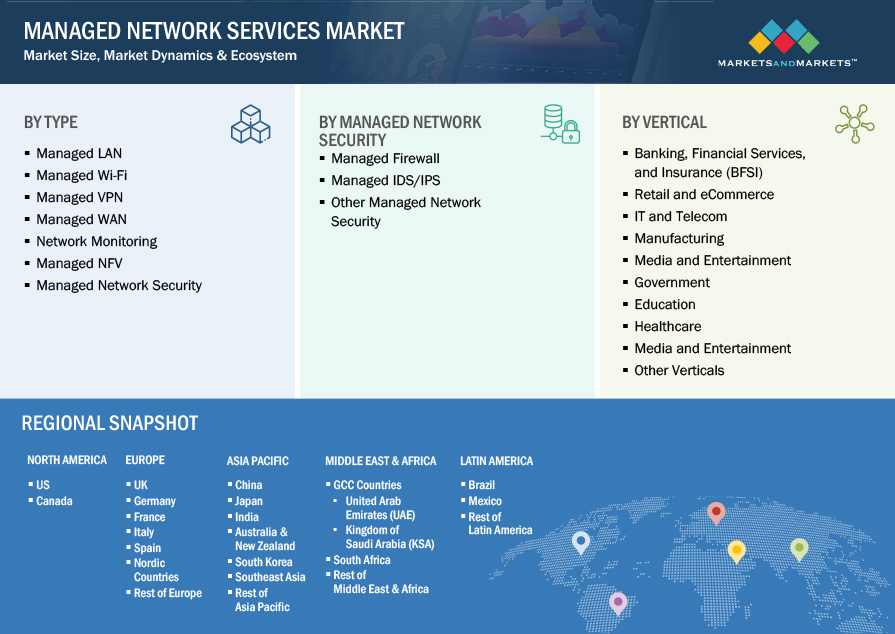
The managed services market is broadly segmented by
Type of services:
- Managed network design services
- Managed network implementation services
- Managed network monitoring services
- Support & maintenance services
Component:
- Managed LAN/WAN networks
- Managed IP telephony
- Managed IP/VPN
- Managed Ethernet links
- Managed video conferencing/telepresence
Organization size:
- Small businesses
- Medium businesses
- Large enterprises
Verticals:
- Banking
- Financial Services
- Insurance (BFSI)
- Retail
- Healthcare & life sciences
- Telecommunication & IT
- Energy & resources
- Public sector
- Media & business services
- Transport & logistics
- Manufacturing industries
Regions:
- North America (NA)
- Asia-Pacific (APAC)
- Europe
- Latin America (LA)
- Middle East and Africa (MEA)
The notable market players in this domain include Alcatel Lucent, IBM, Ericsson, Accenture, and AT&T. The report on managed network services also provides in-depth analysis of the key players in technology and service ecosystems with their profiles, recent developments, key issues, global adoption trends, opportunities in market, and future growth potential.
Managed Network Services (MNS) enable the organizations to outsource their network infrastructure and operations, entirely or partially, to focus on their key business goals. Organizations are facing stiff competition due to scarcity of time, resources, capital funding, and lack of expert systems. MNS helps the companies to reduce the cost incurred on network and IT spending by eliminating capital expenditures and operational expenditures, more than a cost control tool as it helps the organizations to avail a competitive advantage by improving efficiency and providing business differentiation. The demand of new enterprise’s networking objectives is highly complex and requires better expertise to withstand in this vibrant business environment; MNS uses skilled resources and provides the flexibility to companies for expansion and diversification.
The MNS market majorly involves telecom operators due to their strong existing network infrastructure and IT service providers to provide various network architecture services such as design, implementation and monitoring services.
The market is pooled with various big players such as Ericsson, Alcatel-Lucent, Accenture, Nokia Siemens, Huawei, Cisco, and IBM. These companies cater across all business verticals such as telecommunication, retail, transport and logistics, manufacturing, public sector, defense, and education and also serves small and medium business to reduce the cost and enjoy global benefits. Considering its diverse applications and the companies’ need to reduce the operational expenses, MNS seems to be an attractive alternative and expected to grow in a steady pace in the next 5 years.
In this report, the MNS market has been segmented to understand and estimate the market opportunity for components, services, vertical, various sizes of organizations and its market sizes across different business verticals. In managed network components, Internet Protocol-Virtual Private Network (IP-VPN) captures the major share followed by Local Area Network (LAN) and Wireless LAN segment from 2014 to 2019. However, the Year-Over-Year (Y-O-Y) growth in the IP telephony and video conferencing and telepresence market are growing with a fast pace. Europe, the first mover in the MNS market, is expected to be the major contributor by 2019 as well; Asia-Pacific (APAC) and Middle East and Africa (MEA) is expected to surpass its growth with a steady increase in the Y-O-Y growth due to huge growth potential in countries such as China and India. Medium business segment is growing as an attractive segment among mature and emerging markets and telecommunication and public sector verticals occupy a major share in terms of revenue contribution. The MNS market is expected to grow from $30.67 billion in 2014 to $50.83 billion by 2019. This represents a Compound Annual Growth Rate (CAGR) of 10.6% from 2014 to 2019.
The table given below highlights the market trend of MNS market.
MNS Market Size, By Sub segment, 2012–2019 ($Billions)
Source: MarketsandMarkets Analysis
 Exclusive indicates content/data unique to MarketsandMarkets and not available with any competitors.
Table Of Contents
1 Introduction
1.1 Objectives Of The Study
1.2 Market Definition
1.3 Markets Scope
1.3.1 Markets Covered
1.3.2 Years
1.4 Currency
1.5 Limitation
1.6 Stakeholders
2 Research Methodology
2.1 Market Size Estimation
2.2 Market Share Estimation
2.2.1 Key Data Taken From Secondary Sources
2.2.2 Key Data From Primary Sources
2.2.2.1 Key Industry Insights
2.3 Assumptions
3 Executive Summary
4 Premium Insights
4.1 Attractive Market Opportunities In Managed Network Services Market
4.2 Managed Network Services Market Across Various Regions
4.3 Life Cycle Analysis, By Region
4.4 Market Chasm Analysis
5 Market Overview
5.1 Introduction
5.2 Evolution
5.3 Importance Of Managed Network In Managed Services
5.4 Market Segmentation
5.4.1 Managed Network Services Market By Type
5.4.2 Managed Network Services Market By Component
5.4.3 Managed Network Services Market By Organization Size
5.5 Market Dynamics
5.5.1 Drivers
5.5.2 Restraints
5.5.3 Opportunities
5.5.4 Challenges
6 Industry Trends
6.1 Introduction
6.2 Value Chain Analysis
6.3 Managed Network Concepts
6.3.1 Managed Service Provider (Msp)
6.3.2 Customer Premise Equipment (Cps)
6.4 Best Practices, Certifications, And Their Needs
6.4.1 Information Technology Infrastructure Library (Itil)
6.4.2 It Service Management (Itsm)
6.4.3 Ibm Tivoli Unified Process (Itup)
6.4.4 Microsoft Operations Framework (Mof)
6.4.5 Enhanced Telecom Operations Map (Emop)
6.4.6 Federal Information Processing Standards
6.4.7 Unified Certification Standard
7 Managed Network Services Market, By Service Type
7.1 Introduction
7.2 Managed Network Design Services
7.3 Managed Network Implementation Services
7.4 Managed Network Monitoring Services
7.5 Support And Maintenance Services
8 Managed Network Services Market, By Component
8.1 Introduction
8.2 Managed Lan/Wan Networks
8.3 Managed Ip Telephony
8.4 Managed Ip/Vpn
8.5 Managed Ethernet Links
8.6 Managed Video Conferencing/Telepresence
9 Managed Network Services Market, By Organization Size
9.1 Introduction
9.2 Small Businesses
9.3 Medium Businesses
9.4 Large Enterprises
10 Managed Network Services Market, By Vertical
10.1 Banking Financial Services And Insurance (Bfsi)
10.2 Retail
10.3 Healthcare And Life Sciences
10.4 Telecommunication And It
10.5 Energy And Resources
10.6 Public Sector
10.7 Media And Business Services
10.8 Transport And Logistics
10.9 Manufacturing Industries
11 Managed Network Services Market, By Region
11.1 Introduction
11.2 North America (Na)
11.3 Europe
11.4 Asia-Pacific (Apac)
11.5 Middle East And Africa (Mea)
11.6 Latin America (La)
12 Competitive Landscape
12.1 Overview
12.2 New Product Launches
12.3 Agreements, Partnerships, Collaborations, And Joint Ventures
12.4 Mergers And Acquisitions
13 Company Profiles
13.1 Introduction
13.2 Alcatel-Lucent
13.2.1 Business Overview
13.2.2 Products And Servcies
13.2.3 Key Strategy
13.2.4 Recent Developments
13.2.5 Mnm View
13.3 Accenture
13.3.1 Business Overview
13.3.2 Products And Services
13.3.3 Key Strategy
13.3.4 Recent Developments
13.3.5 Mnm View
13.4 At&T Inc.
13.4.1 Business Overview
13.4.2 Products And Services
13.4.3 Key Strategy
13.4.4 Recent Developments
13.4.5 Mnm View
13.5 Cisco
13.5.1 Business Overview
13.5.2 Products And Services
13.5.3 Key Strategy
13.5.4 Recent Developments
13.5.5 Swot Analysis
13.5.6 Mnm View
13.6 Computer Science Corporation
13.6.1 Business Overview
13.6.2 Products And Services
13.6.3 Key Strategy
13.6.4 Recent Developments
13.6.5 Mnm View
13.7 Ericsson
13.7.1 Business Overview
13.7.2 Product And Services
13.7.3 Key Strategy
13.7.4 Recent Developments
13.7.5 Swot Analysis
13.7.6 Mnm View
13.8 Fujitsu
13.8.1 Business Overview
13.8.2 Products And Services
13.8.3 Key Strategy
13.8.4 Recent Developments
13.8.5 Swot Analysis
13.8.6 Mnm View
13.9 Huawei
13.9.1 Business Overview
13.9.2 Products And Services
13.9.3 Key Strategy
13.9.4 Recent Developments
13.9.5 Swot Analysis
13.9.6 Mnm View
13.10 International Business Machines Corporation
13.10.1 Business Overview
13.10.2 Products And Services
13.10.3 Key Strategy
13.10.4 Recent Developments
13.10.5 Swot Analysis
13.10.6 Mnm View
13.11 Nokia Solutions And Networks (Nsn)
13.11.1 Business Overview
13.11.2 Products And Services
13.11.3 Key Strategy
13.11.4 Recent Developments
13.11.5 Mnm View
14 Appendix
14.1 Introducing Rt: Real-Time Market Intelligence
14.2 Available Customizations
14.3 Related Reports












Growth opportunities and latent adjacency in Global Managed Network Services Market: Worldwide Market